Covering a driveway or a gravel bed seems simple, until you compare quotes. The price displayed per bag in stores and the actual cost per square meter, including delivery, often have little in common. To create a budget-friendly garden, the choice of gravel is just as important as how you purchase it.
Actual cost of gravel: what the price per bag doesn’t reveal
A bag of gravel sold for a few euros at a DIY store seems affordable. However, it can take several dozen bags to cover a modest area, and the unit price can quickly add up.
The right approach is to think in terms of total cost delivered to your home. Three factors change the final bill:
- Packaging: a big bag or bulk is significantly cheaper per cubic meter than a batch of 25 kg bags, because packaging and handling are reduced.
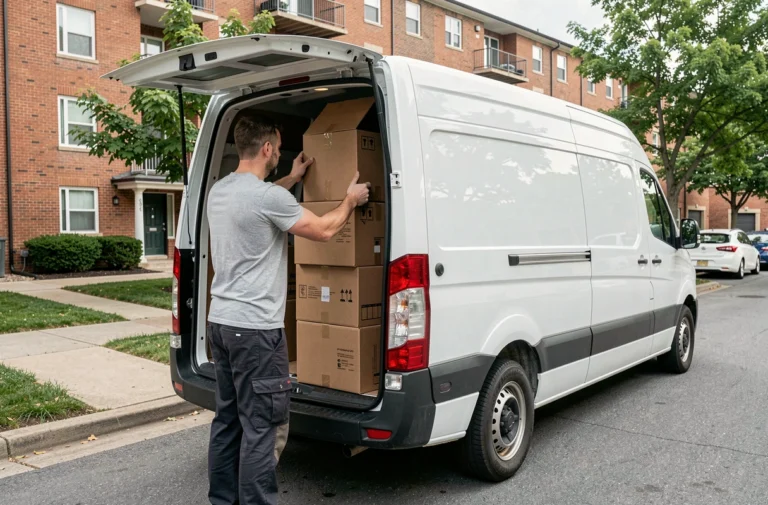
- Delivery: a dump truck that pours bulk into your driveway can represent a high fixed cost, but when calculated per ton, it is often more economical than making multiple trips by car with bags.
- Minimum quantity: some suppliers impose a minimum order volume for bulk, which is only cost-effective if your project exceeds a few square meters.
Before comparing two offers, ask yourself: what is the price per square meter once delivery is included? Gravel that appears cheaper per ton can become more expensive if the supplier charges high transport fees for a small quantity. To explore available options, buying cheaper gravel on Maisonisor allows you to compare prices based on packaging and type of gravel.
Crushed or rolled gravel: the right choice depending on garden use
You may have noticed that some gravels stay well in place underfoot, while others roll and scatter? It’s not by chance; it’s a matter of shape.
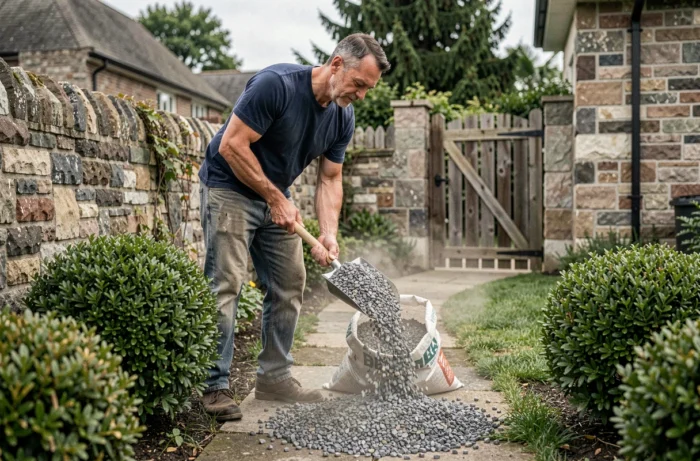
Crushed gravel has angular edges. Its grains interlock and form a stable surface. It’s the logical choice for a driveable path or a frequently used pedestrian walkway. Medium grades (type 6/14 or 10/14) offer a good compromise between walking comfort and stability under the weight of a vehicle.
Rolled gravel, with smooth edges, is better suited for decorative beds or mineral mulching around plants. It feels more pleasant under bare feet, but it easily shifts on a slope or under the wheels of a wheelbarrow.
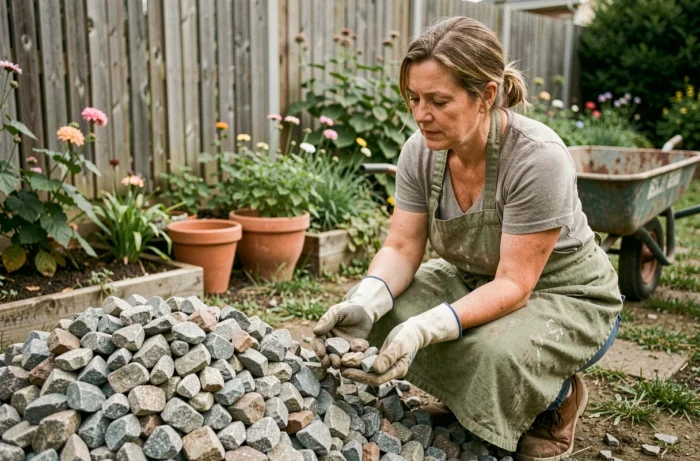
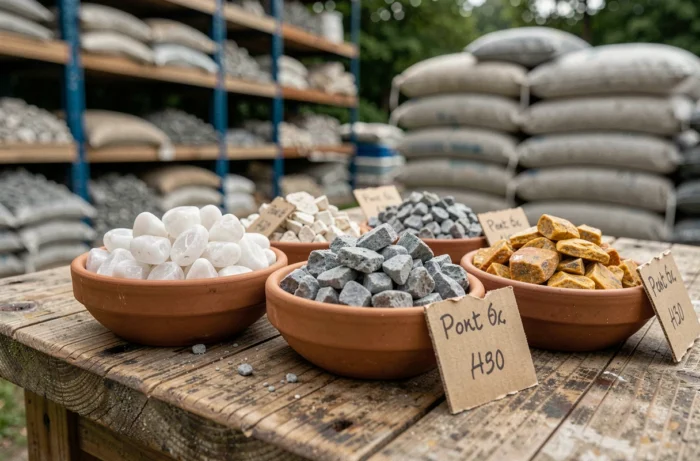
From a budget perspective, crushed gravel from local quarries is often the cheapest. Decorative gravels (white marble, quartz, slate) cost significantly more per ton. If your main goal is to cover a large area at a low price, non-decorative local crushed gravel remains the most economical option.
Soil preparation: the step that prevents paying twice
Placing gravel directly on bare soil guarantees that it will sink within a few months. The soil absorbs the grains, weeds break through, and you have to start all over again.
Geotextile and compacted sub-layer
A geotextile felt laid on the ground prevents the mixing of soil and gravel and slows the growth of weeds. Its cost is modest, and it extends the lifespan of your landscaping by several years. On loose ground, a layer of compacted gravel (a mix of sand and stones of different sizes) under the geotextile stabilizes the whole.
Soil permeability: a point to check before starting
Do you think gravel always allows water to pass through? Not necessarily. A layer of gravel on very compacted soil can cause water to stagnate or run off, just like an impermeable surface. For a driveway, the preparation of the ground and the composition of the different layers are just as important as the finishing material.
Moreover, depending on the municipality, the local urban planning plan (PLU) or stormwater zoning may impose permeability requirements on your plot. Before transforming a courtyard into a gravel surface, it is wise to check these rules at the town hall or on the Urbanism Geoportal.
Reclaimed gravel and reuse: an underestimated option
Buying new is not the only route. Reclaimed gravel circulates among individuals via local classified ads. Demolition or renovation sites produce volumes of sorted rubble or reusable gravel, sometimes given away for free in exchange for removal.
Before rushing in, a few checks are necessary:
- The condition of the gravel: presence of soil, plant debris, or pieces of concrete mixed in. “Free” gravel that requires manual sorting costs time.
- The actual quantity available: ads often overestimate the volume. Ask for an estimate in cubic meters or tons rather than a vague indication (“a pile”).
- The conditions for removal: access to the site, need for a suitable vehicle, time frame to remove the material.
The reuse of materials is still underdeveloped in France, but local platforms are beginning to structure these channels. It’s worth searching before placing an order with a traditional supplier.
Bulk, big bag, or bag: which format for which garden
The purchase format directly depends on the area to be covered and the accessibility of your land.
For a small bed or a border of a few square meters, bags remain practical. You can measure precisely, without surplus, and transport them in a car trunk.
For a driveway of several dozen square meters, the big bag (often around a ton) offers a better quantity-price ratio. It is delivered by a crane truck and placed where desired.
Bulk delivered by dump truck is the cheapest format per ton, suitable for projects exceeding several cubic meters. The constraint: sufficient access for the truck and a clear unloading area. If your garden is at the end of a narrow dead-end, bulk is not feasible.
Cheap gravel for the garden is ultimately mostly a matter of well-thought-out logistics. Choosing local crushed gravel in bulk, properly preparing the soil with a geotextile, checking delivery constraints, and exploring the reuse option: these four decisions weigh more than the unit price displayed on the shelf.