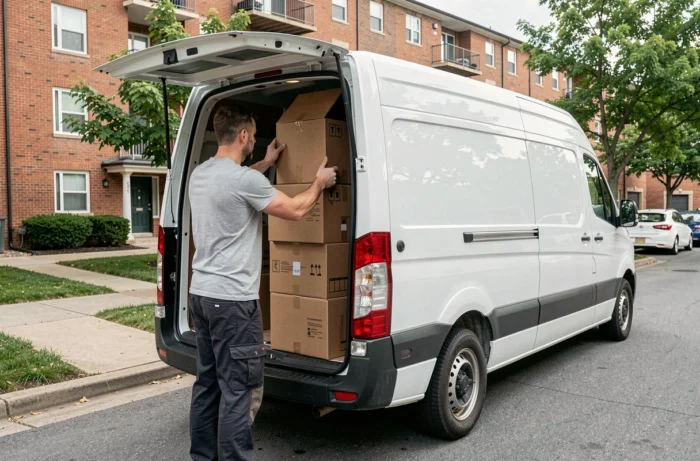
Renting a large van for a move seems simple on paper: you choose the largest available volume, load it up, and drive. The reality is more technical. Between the payload that doesn’t always match the displayed volume, circulation restrictions in urban areas, and the subtleties of the B license, the choice of a so-called “jumbo” van deserves more careful consideration than just comparing cubic meters.
Payload of a jumbo van: the figure that rental companies don’t highlight
Most rental comparison sites classify vehicles by volume: 12, 16, 20 cubic meters. This criterion guides the choice, but it masks a data point that is often more constraining.
A large van close to 3.5 tons of GVW can display a generous volume while leaving a limited payload margin. Once the empty weight of the vehicle, the driver, a potential passenger, fuel, and safety equipment are deducted, the actual capacity for your furniture and boxes can sometimes be significantly reduced.
The reflex to adopt before signing any contract is to ask for the value listed in box F.2 of the vehicle’s registration document. This box indicates the GVW, and it is the difference between this GVW and the empty weight (box G.1) that gives the actual payload. A difference of a few hundred kilos between two models of the same volume can shift a move from a single trip to two round trips.
For moves involving heavy appliances (washing machines, refrigerators, digital pianos), this verification becomes a priority, well before the number of cubic meters. If you are considering renting a jumbo van from Auto Wog, checking the payload of the proposed model remains the first concrete step before confirming the reservation.

B license and jumbo van: where the legal limit lies
The term “jumbo” is a marketing argument, not an administrative category. It generally refers to the largest vans in a range, but the B license only covers vehicles with a GVW not exceeding 3.5 tons. Beyond that, a higher category of license is required.
The confusion arises because some models with a liftgate or reinforced floor exist in several versions. The same commercial name can correspond to a GVW of 3.3 tons in one configuration and 3.8 tons in another. The difference lies in the onboard equipment and options chosen by the rental company.
Before booking, three checks are essential:
- The exact GVW of the proposed vehicle, not that of the generic model displayed on the rental company’s website, but that of the specific vehicle that will be made available
- The category of license mentioned on the registration document, ensuring that the main driver possesses it
- The presence of a liftgate, which adds weight to the vehicle and reduces the available payload for loading
A roadside check with a vehicle whose GVW exceeds the driver’s license category results in the vehicle being immobilized and a fine. The risk is not just theoretical: field reports show that this situation regularly occurs during moves between individuals.
Vehicle height and low emission zones: two often-overlooked route constraints
Large jumbo-type vans can exceed three meters in total height. This data does not change the required license, but it has very concrete consequences on the route.
A standard covered parking lot often limits height to two meters. The height restrictions of certain urban tunnels, the archways of Haussmannian buildings, or the entrances of recent residences can also pose problems. Measuring the exact height of the vehicle before departure and comparing it to the announced limits on the planned route avoids last-minute detours, which can sometimes be impossible in narrow streets with a vehicle of this size.

Crit’Air sticker and circulation restrictions
Low emission zones (LEZ) add an additional constraint. In these areas, the Crit’Air sticker is mandatory for light commercial vehicles, and local authorities can prohibit the circulation of certain categories based on their pollution level.
An older rental vehicle, even offered at a reduced rate, may not be allowed to circulate in the delivery area on the day of the move. Checking the Crit’Air sticker of the proposed vehicle should be part of the discussion with the rental company, just like volume and payload.
Rules frequently evolve and vary from one metropolitan area to another. The website of the Ministry of Ecological Transition publishes the updated map of LEZs in effect.
Optimizing the loading of a jumbo van for a single trip
A large volume vehicle that is poorly loaded wastes space and exposes items to shocks. Two principles allow you to make the most of the floor space of a jumbo van.
The first concerns weight distribution. The heaviest items should be placed at the back, against the partition with the cabin, and as low as possible. This stabilizes the vehicle while driving and limits mass transfer during braking.
The second relates to the use of height. Dismantled furniture (table legs, shelf supports) should be slid vertically along the walls. Boxes should then be stacked from the heaviest on the ground to the lightest on top. Each layer should form a stable plane before placing the next one.
- Protecting the corners of furniture with blankets or corrugated cardboard reduces friction during transport
- Strapping the first rows before continuing loading prevents chain slipping
- Keeping access clear to the sliding side door allows for retrieving an item without unloading everything
A standard move for a medium-sized apartment generally fits in a single trip with a jumbo van, provided that the loading has been planned in advance. The time and energy saved compared to two round trips in a smaller vehicle often justifies the rental price difference.
The choice of a jumbo van relies on a trade-off between volume, payload, dimensions, and regulatory compatibility. A vehicle perfectly suited to the volume of furniture can become unsuitable if its height blocks access to the delivery location or if its Crit’Air sticker does not match the LEZ crossed. Asking these questions to the rental company before booking transforms a stressful move into a controlled operation.