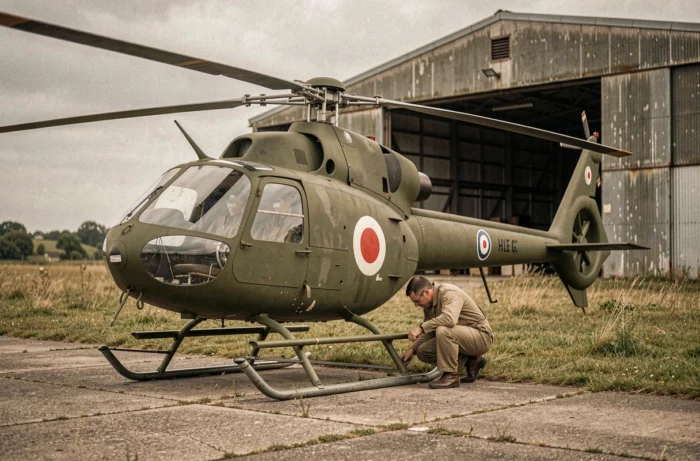
The French Army operates two-thirds of the country’s military helicopter fleet. Behind this figure lies a story where each generation of aircraft has redefined the way to fight on the ground. From the first flights of the Alouette in Algeria to the dronization projects of the 3rd Combat Helicopter Regiment, French military helicopters have changed their roles as much as their shapes.
When the employment doctrine transforms a helicopter into a weapon
Talking about the evolution of French military helicopters by aligning technical sheets misses the point. What really changes from one decade to another is not just the engine or avionics. It’s the way the army thinks about the use of the machine.
Let’s take a concrete example. The Gazelle, introduced in the 1970s, is a light, fast, and lightly armored aircraft. It was designed for reconnaissance and observation. Over time, the army added HOT anti-tank missiles and then a night vision targeting system (the Viviane version). A reconnaissance aircraft became a tank hunter.
This shift is not a technical detail. It reflects a doctrinal evolution: aeromobility, meaning the ability to rapidly project force by air, has shifted from a logistical support role to an offensive role. To delve deeper into this trajectory, one can consult the French Army helicopter on Communiqués du Net, which outlines the key stages of this transformation.
With the return of high-intensity combat in military planning, the doctrine is evolving further. The helicopter is no longer just the fire support that intervenes when ground troops are pinned down. It is now expected to strike deep into the enemy’s setup, even before ground engagement, to neutralize command centers or stop tank columns.
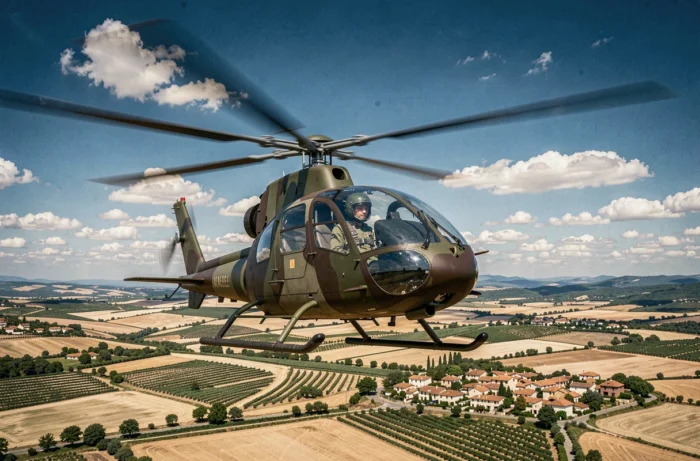
Alouette, Puma, Tiger: three generations, three ways of fighting
The Alouette II, produced by Aérospatiale, was the first French helicopter to be used extensively in operations. In Algeria, it provided medical evacuation and light transport for commandos. Its role remained auxiliary: it extended the action of ground troops without replacing it.
The Puma SA 330, which arrived in the 1960s-1970s, changed the scale. Heavier and capable of transporting a full section, it enabled vertical assault, meaning the deployment of soldiers directly onto a target. The Puma made the helicopter an autonomous tactical vector.
The gradual withdrawal of the Puma is underway, including in overseas deployments. In Djibouti, the NH90 Caïman is taking over. This transition does not only change the equipment: it reconfigures the capabilities available in each theater of operations.
The Tiger, a combat helicopter introduced in the early 2000s, represents a break. Designed from the outset for combat, it carries cannons, rockets, and missiles. It has been deployed in Afghanistan, Libya, and Mali, where it has conducted fire support and armed reconnaissance missions in very different environments.
From Tiger to Tiger Mark III
The Tiger Mark III program plans for a deep modernization of the aircraft. The goal is to integrate new connectivity and collaborative combat capabilities, so that the helicopter can exchange data in real-time with other platforms, including drones.
The Tiger Mark III is not a new helicopter; it is a new weapon system. The airframe remains similar, but the onboard electronics and engagement modes change radically.
NH90 Caïman and H160M Guépard: the ongoing transition in the French army
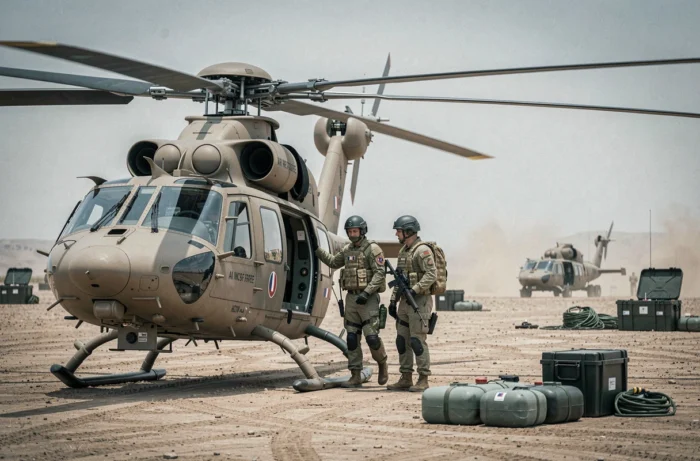
The NH90 Caïman is gradually replacing the Puma and Cougar in the army’s light aviation regiments (ALAT). Its special forces version is expected to equip the 4th RHFS, the special forces helicopter regiment.
Why does this specialization matter? Because special forces missions (clandestine insertion, extraction under fire, night operations) require specific equipment:
- Navigation and flight systems compatible with night vision goggles, for very low altitude approaches without lighting
- Enhanced armor and electronic countermeasures suited to the ground-to-air threats encountered in contemporary theaters
- Self-protection and in-flight refueling capabilities for long-distance raids deep into enemy territory
The H160M Guépard is the next light joint aircraft. It is set to replace several aging fleets (Fennec, Dauphin, Alouette III still in service in some units). Its uniqueness lies in being a common helicopter for the army, navy, and air force, simplifying maintenance and training.
Dronization and air combat: what is changing for military helicopters
The 3rd Combat Helicopter Regiment is engaged in the integration of drones into its operations. This is not a replacement for piloted aircraft. It is a complementarity: the drone explores a dangerous area, transmits data, and the helicopter intervenes with precise knowledge of the threat.
Dronization modifies air combat without eliminating the pilot. The helicopter remains the decision-making and strike vector, but it no longer enters the unknown first.
This evolution raises a question of availability. Modernizing existing aircraft, integrating new systems, training crews in collaborative man-machine tactics: all of this takes time and resources. Technical progress does not automatically translate into increased operational capability. An aircraft undergoing modernization is temporarily unavailable.
The military programming law 2024-2030 plans for staggered deliveries of NH90 and Guépard, but the pace of withdrawal of older aircraft creates windows of vulnerability. Regiments must juggle between aging fleets and new aircraft whose ramp-up is gradual.
The history of French military helicopters is not one of linear progress. Each generation has responded to a doctrine, a theater of operations, a budget constraint. The next step, that of collaborative combat between helicopters and drones, is already underway. It is being played out as much in design offices as in the regiments that must, on a daily basis, maintain their ability to take off.