
Buying a hammer and a drill is not enough to create a functional workshop. Before making a list of equipment for DIY at home, it’s essential to examine what separates suitable tools from poorly calibrated investments: the type of work intended, the frequency of use, and the actual costs, including rentals.
Rental or purchase of tools: a comparison of actual costs
Most articles on DIY tools assume that everything is purchased. Renting is gaining traction, especially for equipment used once or twice a year. A partnership between E.Leclerc and the Poppins app allows for the rental of drills, sanders, or hand trucks at certain drive-thrus in the Lille metropolitan area, starting at 5 euros per day depending on the equipment.
The displayed price does not always reflect the final cost. Deposits, damage waivers, theft insurance, and consumables (discs, bits, blades, abrasives) are often charged separately. A feedback report published in September 2026 confirms that consumables represent a frequently overlooked additional cost in the calculation.
| Criterion | Purchase | Rental |
|---|---|---|
| Initial Cost | High (one-time investment) | Low (daily rate) |
| Consumables | At your expense, free choice | Often charged additionally |
| Deposit / Insurance | None | Variable, sometimes significant |
| Relevance | Regular use (several times a month) | Occasional use (1 to 2 times a year) |
| Storage | Requires dedicated space | None |
For a drill or jigsaw used every month, purchasing remains more cost-effective. For an orbital sander or wall cutter used twice a year, renting should be calculated by including all additional costs. The resources available on the equipment section of Blog du Bricoleur allow for comparing ranges before deciding between these two options.
Hand tools and power tools: prioritize according to your projects
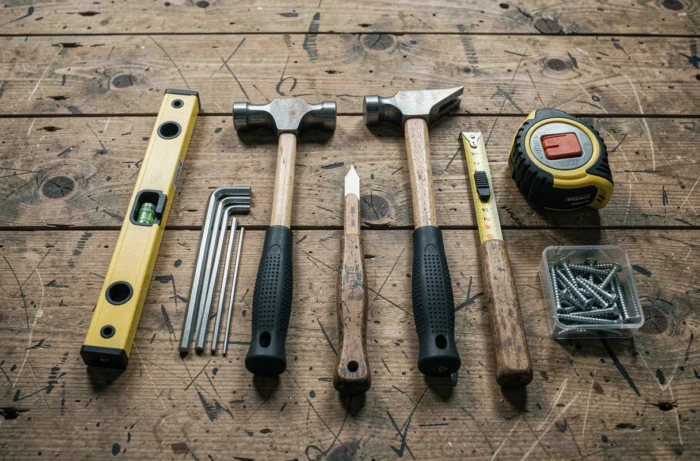
All guides list hammer, screwdriver, pliers, tape measure, and level. These hand tools form the foundation, but their quality matters more than their quantity. A set of screwdrivers with interchangeable bits replaces a dozen individual screwdrivers. A well-calibrated adjustable wrench covers more situations than a collection of specialized pliers.
Hand tools: the foundation of the toolbox
- A tape measure of at least five meters and a level for any reliable measurement before cutting or installation
- A set of flat and Phillips screwdrivers (or a magnetic bit screwdriver) to cover most household screws
- An adjustable wrench and cutting pliers for light plumbing work and small wiring
- A versatile claw hammer, suitable for carpentry as well as furniture assembly
A good hand tool lasts for decades if the material is appropriate. Chrome-vanadium steel for screwdrivers, forged steel for the hammer: these technical indicators are worth more than a marketing label.
Power tools: drill, saw, and sander
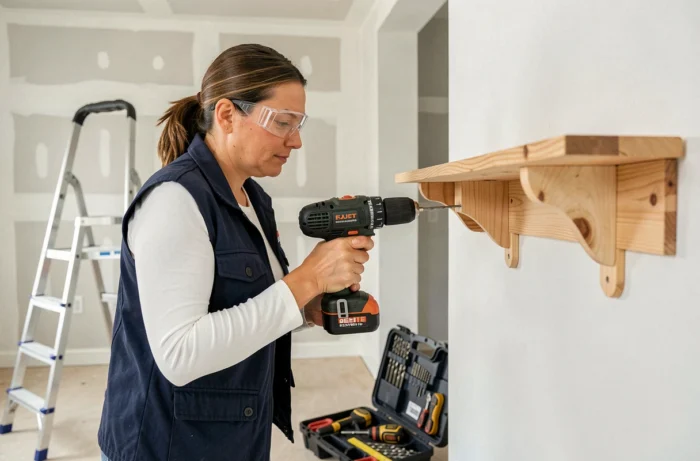
The cordless drill-driver is the first power tool to acquire. It is used for drilling, screwing, and, with the right chuck, light sanding. The torque and battery life determine the actual versatility of the device.
The jigsaw comes second. It cuts wood, laminate, and thin metal depending on the blade used. However, for long, straight, and repeated cuts in thick panels, the circular saw remains more precise and faster.
The sander, whether vibrating or orbital, is used in furniture renovation projects or surface preparation before painting. Its use is often occasional, making it a natural candidate for rental.
Safety and diagnostics before work: equipment that lists often forget
Personal protective equipment rarely appears at the top of tool lists. Safety glasses, gloves suitable for the material being worked on, and hearing protection for power tools are a minimum. A safety equipment costs a fraction of the price of a drill, but its absence can turn a trivial DIY task into a domestic accident.
Asbestos and lead diagnostics: a technical step before certain works
Drilling a wall or removing an old covering in a building constructed before 2000 requires a precaution often ignored by amateur DIYers. Regulations require a diagnostic before work when materials that may contain asbestos or lead are involved.
A lead diagnostic (CREP) identifies coatings containing lead, particularly old paints. This check must be organized before the intervention when there is a risk of exposure. The asbestos diagnostic follows the same logic for spray insulation, floor tiles, or fibrocement ducts.
These diagnostics do not fall under the DIY work itself, but they condition the feasibility of certain projects. Ignoring them exposes one to documented health risks and, in the case of declared work, to administrative complications.
Workshop and storage: organizing the workspace
A stable workbench, even a folding one, changes the quality of work. Securing a piece in a vise fixed to a rigid surface provides a precision impossible to achieve when holding the piece with one hand. Folding trestles complete the setup for cutting panels or long boards.
Storage affects efficiency as much as the tools themselves. A compartmentalized toolbox for small materials (screws, plugs, bits) and a wall-mounted pegboard for hand tools allow for finding each item without rummaging. A well-organized workshop reduces the time spent searching more than on DIY.
The choice of DIY equipment relies less on quantity than on the suitability between the material, the frequency of use, and the type of projects. Renting meets occasional needs, purchasing secures regular uses, and diagnostics before work remain a blind spot that every DIYer should check before plugging in the drill.