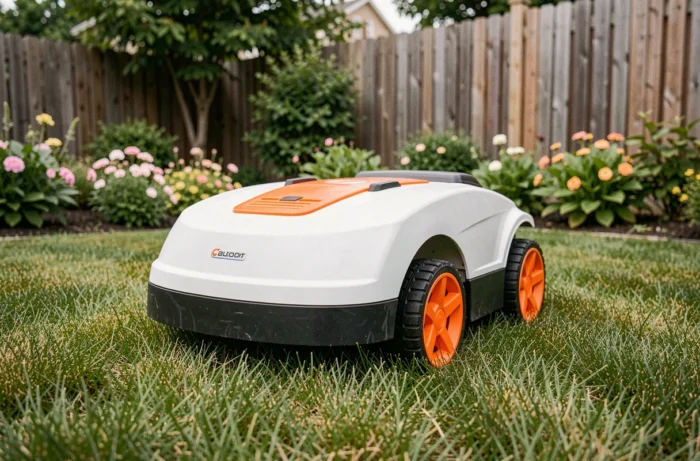
The Gardena R50Li is a robotic mower designed for lawns up to 500 m² in area. A historic model in the Gardena range, it operates with a boundary wire and returns to its charging station on its own. However, in light of the rapid evolution of the robotic mower market, its technical features deserve careful examination, particularly regarding durability and the availability of parts.
Technical specifications of the Gardena R50Li compared to its direct competitors
| Criterion | Gardena R50Li | Competing robots (same surface range) |
|---|---|---|
| Maximum area | 500 m² | 500 to 600 m² depending on the model |
| Announced maximum slope | 25 % | 25 to 35 % generally |
| Noise level | 58 dB | 55 to 60 dB |
| Cutting height | 20 to 50 mm | 20 to 60 mm depending on the model |
| Navigation type | Boundary wire (random) | Boundary wire or wireless (RTK/GPS) |
| Cutting system | Mulching | Mulching |
The R50Li is positioned in the lower average of its category for slope management, with a capacity limited to 25 % maximum slope. Some product sheets mention a value of 100 %, but this data seems to correspond to another reference or an error in reporting. The figure of 25 % should be retained, consistent with Gardena’s specifications.
To delve deeper into each operational parameter, consulting a review of the Gardena R50Li allows for cross-referencing user feedback with manufacturer data.
Battery and spare parts: the true cost of the R50Li over time
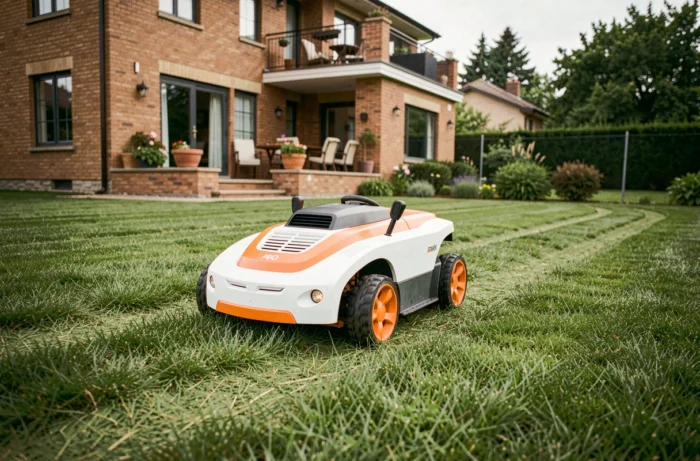
The initial purchase price of the R50Li has always been presented as its main selling point. However, the battery poses the primary economic risk in the medium term. Compatible batteries are available on the market, with varying capacities depending on the sellers.
This availability of adaptable parts presents both an advantage and a simultaneous disadvantage. The cost of bringing the mower back into service can remain moderate, but the quality, electronic compatibility, and warranty are not uniform from one supplier to another.
Peripheral parts to watch
The repairability of the R50Li is not limited to the battery. Several components are available as compatible replacement offers for older Gardena and Husqvarna references:
- The power supply and charger of the charging station, which may wear out after several seasons of outdoor use
- The boundary wire and its connectors, sensitive to mechanical damage (spade, aerator, burrowing animals)
- The cutting blades, a classic consumable whose replacement frequency depends on the programmed mowing density
A second-hand buyer or long-time owner must assess the actual availability of parts before extending the use of the robot. The R50Li belongs to an older generation, and Gardena’s official customer service does not guarantee unlimited supply.
Boundary wire navigation: concrete limits on the ground
The R50Li uses random movement within the perimeter defined by its wire. This system has proven effective for simple gardens of regular shape. In contrast, L-shaped terrains, gardens with central flower beds, or narrow passages between areas pose coverage problems.
Random mowing means that some areas are covered multiple times while others are reached later. On a well-cleared 500 m² area, the result remains satisfactory if the robot operates regularly. On a compartmentalized terrain, the cutting quality becomes uneven.
Installation of the wire: a time investment
The initial installation of the boundary wire requires several hours depending on the garden configuration. The wire must precisely follow the edges, navigate around fixed obstacles, and be secured to the ground with stakes. After a few weeks, the grass covers the wire, making it invisible.
This installation step distinguishes the R50Li from newer robots that operate wirelessly, using RTK or GPS mapping. The wire remains a reliable technology, but it imposes an initial constraint that current models eliminate.
Gardena R50Li: still relevant mower or outdated model?
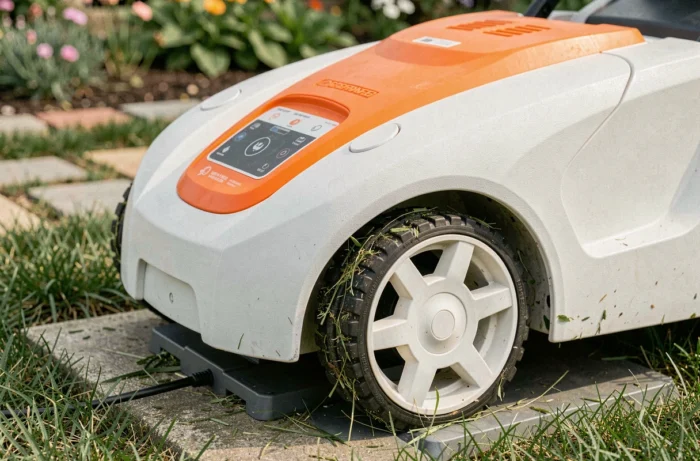
The R50Li is no longer sold new by most retailers. The visible offers come from second-hand markets, clearance sales, or parts replacements. Gardena has evolved its range towards the Sileno models, which offer additional features (connectivity, management of multiple zones, improved sensors).
For a garden of less than 500 m², flat and without major obstacles, the R50Li remains a functional robot if it is in good condition. Its noise level of 58 dB allows it to operate without disturbing the neighbors, even in the evening.
- Strengths: effective mulching, quiet operation, sufficient autonomy for small areas
- Weaknesses: random navigation, lack of connectivity, mandatory boundary wire
- Critical point: availability of parts and compatible batteries, to be checked thoroughly before any second-hand purchase
The choice between keeping an R50Li and upgrading to a Sileno model or competitor primarily depends on the condition of the existing battery and wire. If these two elements are functional, the robot can still provide several seasons of mowing. If a battery replacement is necessary, calculating the total cost in relation to the price of a recent model is worth considering.