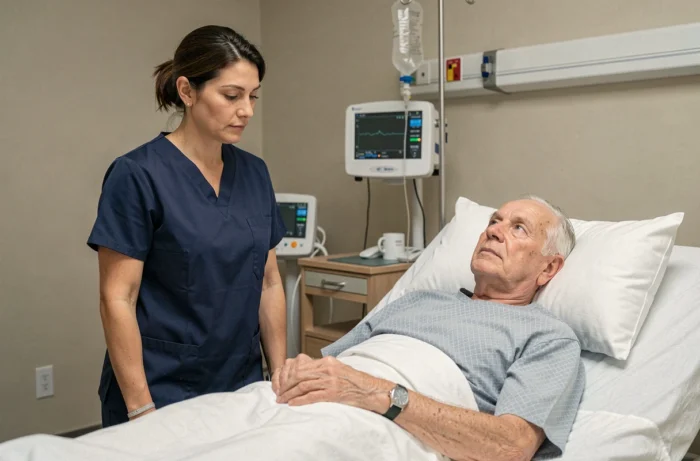
In a palliative care unit, a nurse adjusts the lighting, rearranges the room and adapts the pace of care to the patient. She is not following a conventional biomedical protocol: she is working with the interaction between the person and their environment. This type of practice, often intuitive, has a solid theoretical foundation in the model developed by Martha Rogers during the second half of the 20th century.
Energy fields and a unitary perspective: how Rogers changes the nursing approach
Most nursing models divide patients into needs (physiological, psychological and social). Rogers proposes a reversal of this approach: the person is an energy field that cannot be reduced to its parts. Care is not directed at an organ; it involves interacting with a dynamic whole that is inseparable from its surrounding environment.
In practical terms, for a care team, this means that changing an environmental factor (noise, lighting or the presence of a loved one) can affect the patient’s condition just as much as a technical procedure. Care is not limited to medical interventions: it also includes shaping the living environment and fostering a quality relationship.
This approach can be found in highly practical settings. In a neonatal intensive care unit, adjusting the lighting and reducing background noise are not merely matters of comfort. They are interventions in the child’s energy field, in the sense intended by Rogers. To explore Martha Rogers’ theory in greater depth, it is important to understand that the concept of an energy field is not a metaphor: it underpins the entire clinical practice that follows from it.

Principles of the science of unitary human beings in practice
Rogers formulated several principles that shape her perspective. Three of them have a direct impact on how care is planned.
- Principle of integrality: the person and their environment interact continuously and simultaneously. In practice, a patient cannot be assessed without also considering their context (room, people around them and daily routine).
- Principle of resonance: life patterns change, moving from lower to higher frequencies. For caregivers, this means that patients are constantly changing, and interventions should follow this movement rather than freeze them in a particular state.
- Principle of helicy: change is continuous, innovative and unpredictable. There is no going back. Applying this principle in practice means accepting that a fixed care plan will lose its relevance and must be continually reassessed.
These three principles are not philosophical abstractions. They guide practical decisions: when to reassess a care plan, how to incorporate the patient’s environment into clinical reasoning, and why a standardized approach may fail when a patient’s life patterns are changing rapidly.
Rogers’ theory and nursing research: a framework that goes beyond philosophy
A common criticism of Rogers’ model is its level of abstraction. Concepts such as energy fields, patterns and pandimensionality may seem far removed from the day-to-day realities of a hospital ward.
This criticism has merit, but it needs to be put into perspective. Rogers herself encouraged a range of research methods, both qualitative and quantitative, to test and refine her model. Methodological studies have explored how the science of unitary human beings can inform empirical research protocols, rather than serving only as a basis for theoretical reflection.
The theory’s terminology has also evolved over the course of its publication history. The use of the term “unitary” and the boundaries of this nursing science have become more clearly defined, challenging the idea that the model was fixed once and for all in the 1970s.
Theoretical developments stemming from the Rogerian model
Rogers’ legacy extends beyond her own model. Several theorists have developed related frameworks, exploring concepts such as self-transcendence and the experience of carrying on through difficult times. These developments show that the Rogerian model functions as a conceptual framework capable of generating new theories suited to specific clinical situations.
This ability to inspire further theoretical developments sets Rogers apart from more prescriptive approaches. Rather than a protocol, her work offers a system of thought that guides clinical reasoning.

Putting the model into practice: the practical challenge of Rogers’ theory
The main obstacle to adopting this model in practice remains translating abstract concepts into usable tools. How do you assess an “energy field” during a nursing handover? How do you document a “pattern” in an electronic health record?
In practice, teams that draw on this approach often take a holistic observational approach: they note how patients respond to changes in their environment and adjust interventions based on perceived changes rather than standardized indicators. This method requires specific training and observation time, which organizational constraints do not always allow.
Differences in how the model is applied are real: in a palliative care unit with sufficient time and resources, the Rogerian model can be fully realized. In a busy emergency department, its integration remains partial and depends on the team culture.
Four fundamental nursing concepts and Rogers’ place among them
Every nursing theory is built around four concepts: person, health, environment and nursing. Rogers stands out for the importance she gives to the environment and its interaction with the person, whereas other models (Henderson, Orem) place greater emphasis on individual needs or patient autonomy.
This difference is more than a minor detail. It shapes data collection, the formulation of nursing diagnoses and the choice of interventions. A caregiver trained in Rogers’ model will ask different questions during an initial assessment than one trained in Virginia Henderson’s model.
Martha Rogers’ model remains a key reference in nursing education, even though its direct clinical adoption varies by setting. Its strength lies less in providing a protocol than in offering a way to think about care, centered on the dynamic relationship between the person and their environment. For teams willing to invest in this approach, it is a clinical reasoning tool that broadens the range of possible interventions.